


Introduction
This article shares a clinical case reflection from my years of Traditional Chinese Medicine practice. It is intended for educational purposes only and does not suggest that any treatment can cure, reverse, or prolong life in every critically ill patient.
The patient was an 86-year-old woman who had been in a long-term vegetative state and hospitalized for more than two years. Her family contacted me during a very difficult stage, when her condition had become extremely fragile and conventional medical treatment options were reportedly very limited.
According to the family, her blood pressure had dropped to approximately 55/28 mmHg, and her heart rate was around 25 beats per minute. They were told that the medical team had very little expectation of meaningful recovery. The family hoped to explore whether Traditional Chinese Medicine could provide supportive care during this late stage.
I told them honestly that I could not promise any outcome. At such a critical stage, any intervention must be approached with caution, humility, and respect for the patient, the family, and the hospital’s medical team.
Initial Presentation
When I visited the patient, her overall condition appeared extremely weak.
The family and caregivers reported the following:
• Very low blood pressure and heart rate
• Generalized swelling
• Pitting edema in both lower limbs
• Abdominal fluid retention
• Very little urine output
• Bowel movement only once every three to five days
• Cold skin and low body temperature, around 34°C
• Dry skin
• Pale, dull complexion
• Weak and shallow breathing
From a Traditional Chinese Medicine perspective, her tongue appeared pale, slightly dusky, with a white and slippery coating. Her pulse was deep, slow, thin, and weak.
TCM Pattern Identification
Based on Traditional Chinese Medicine theory, this presentation suggested a pattern of:
Spleen and Kidney Yang deficiency, severe depletion of original Qi, and internal water retention.
In TCM, the Spleen and Kidney Yang are closely associated with warmth, transformation of fluids, and support of basic physiological vitality. When Yang Qi becomes severely depleted, the body may lose its ability to warm the tissues, move fluids, and maintain normal functional activity.
This type of pattern may present with coldness, edema, low energy, weak pulse, reduced urination, and signs of fluid accumulation.
Treatment Principle
The treatment principle was:
Warm Yang, support Qi, assist fluid metabolism, and strengthen the body’s remaining vitality.
A modified formula based on Zhen Wu Tang and Shen Fu Tang was considered from a TCM pattern-based perspective.
Herbal Approach
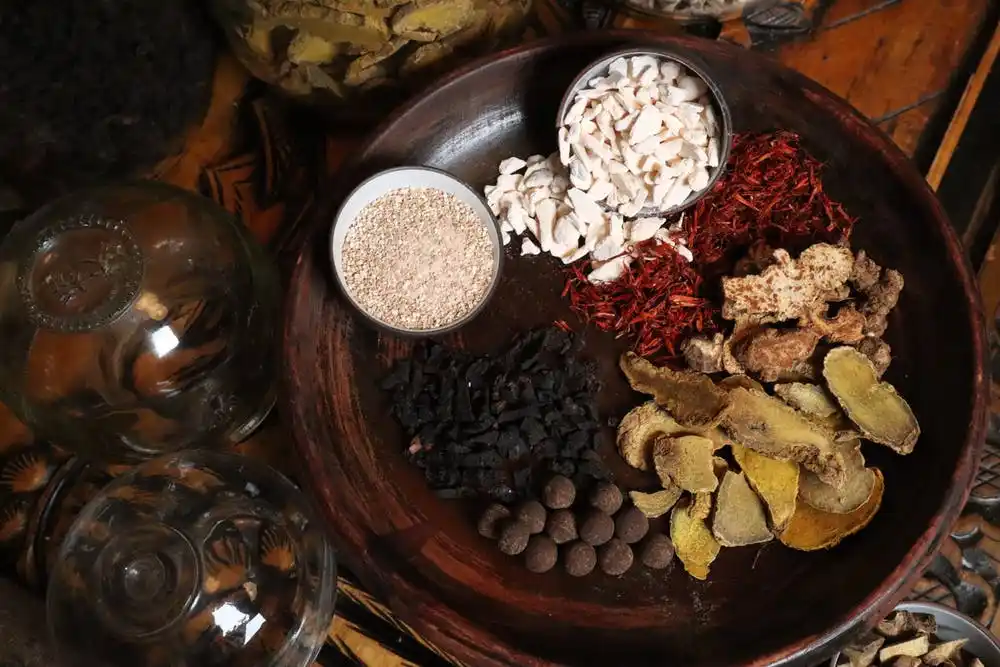
The herbal ingredients included:
• Fu Zi
• Hong Shen
• Gui Zhi
• Bai Shao
• Fu Ling
• Sheng Jiang
• Bai Zhu
• Huang Qi
• Dan Shen
• Chuan Xiong
• Zhi Gan Cao
The key herbs used in this TCM strategy included Fu Zi, Hong Shen, and Huang Qi, which are traditionally used to warm Yang, support Qi, and strengthen vitality in appropriate patterns.
Because the patient was unable to take herbs orally, the formula was administered through feeding support under the family’s care and hospital circumstances.
Important safety note: Fu Zi is a potent herb and must be properly processed and used only under the supervision of a qualified practitioner. It is not suitable for self-use.
Family-Reported Changes
At the beginning, I did not expect much. The patient’s condition was already extremely critical.
However, the family later reported that after the herbal support began, the patient’s blood pressure and heart rate appeared to rise, urination increased, and swelling seemed to improve. These observations were reported by the family during the course of care.
From a medical and legal perspective, it is important to say clearly: this was an individual case observation. It does not prove that the herbal formula alone caused these changes, and it does not mean similar results can be expected in other critically ill patients.
Outcome
According to the family, the patient survived for another 113 days after this TCM supportive care began.
For the family, those additional days were emotionally meaningful. For me as a practitioner, this case was a reminder that even when recovery is no longer realistic, Traditional Chinese Medicine may still have a role in supportive, comfort-oriented, and constitution-based care when used responsibly and appropriately.
Clinical Reflection
This case does not represent a miracle cure. It should not be understood as a claim that Chinese herbs can reverse end-stage illness or replace emergency medical care.
Instead, it illustrates several important points:
1. In Traditional Chinese Medicine, treatment is based on pattern identification rather than disease name alone.
2. In late-stage weakness, coldness, edema, and weak pulse may suggest severe Yang deficiency and Qi depletion.
3. Supportive TCM care must be individualized and carefully supervised.
4. Critically ill patients should remain under appropriate medical care, especially when vital signs are unstable.
5. Family expectations must be handled honestly, with no promise of cure or life extension.
Final Thoughts
Traditional Chinese Medicine has a long history of caring for patients with complex and chronic conditions. In some cases, its value may not be in “curing” disease, but in supporting the body, improving comfort, and addressing patterns of imbalance that conventional labels may not fully describe.
Every patient is different. Any herbal treatment, especially in critically ill elderly patients, should be guided by a qualified practitioner and coordinated with the patient’s medical care team whenever possible.
________________________________________
Disclaimer
This article is for educational and informational purposes only. It is not medical advice, diagnosis, or treatment. The case described here is an individual clinical experience and does not guarantee similar results. Patients with low blood pressure, slow heart rate, severe edema, reduced urination, altered consciousness, or any life-threatening condition should seek immediate medical attention. Herbal medicine should be used only under the guidance of a qualified healthcare professional.